Pages

Wednesday, April 21, 2010

More Turkey Stories

Turkey season is still going strong and for some it is just about to get started. Below are a few more pictures of our recent success. This has been a good year for me.

Since I had already killed two birds this year I was going to let Danny shoot that morning. When he said he was going to hold out for a nice tom I brought my bow because I am NOT that picky!

After a little calling and having some hens within feet of our blind we spotted a tom behind us. We thought it was a jake because of its little beard, so Danny took the camera and I grabbed my bow.

Hunting in the mountains gives the turkeys an infinite amount of places to hide. If a wounded birds gets his wings he can be danged near impossible to find. So I decided to try out one of those Bullhead turkey broadheads. The results were devastating.

The tom gave me a 15+ yard shot and I hit him right above the caruncles. He started flapping and running off so we exited the blind immediately to chase him and shoot again if need be. We did NOT want to lose a bird in the mountains. The chase lasted about 75yds, he had expired, and bled A LOT.

A short video f the hunt:
Took my brother-in-law on his first turkey hunt this past week. We went to a totally new place not really knowing what we would find. We were pleasantly surprised when we got there to find the birds were roosting a few fields away from camp. Some even roosted within 100 yds from camp. We also had along another friend who has turkey hunted but has never had any luck, and never with a bow.

Camp was nice, right along a creek in the timber.

The first night was a bit of a scouting expedition but we still managed to get within ten yards of two really nice toms while still hunting. Didn't even come close to drawing the bow back though, they spotted me making the slightest of movements. I KNOW BETTER! Rookie mistake, but we found where they roosted and were going to back in the morning with the blind.

Next morning no less than 50 turkeys were absolutely going nuts on the roost. Of course the main flock headed the other direction, but we had these four young toms/jakes come to check us out.

My brother-in-law (Kelly) has become a danged good shot in the year that he's been in to archery, and I fully expected him to kill a bird. I didn't take into account what a little "turkey-fever" could do to a guy's shooting though. You can see a blur of yellow that was his arrow in this picture. He was about 4 inches in front of the turkey. DANG!

I had no intentions of being the shooter later that night but the only shot we had was out of one of the blind windows that Kelly could not shoot through. I one upped Kelly by shooting through the feathers of a young jake.

The next morning we moved closer to the roost hoping we could get more action, and boy did we. We had turkeys all around us all morning. We had talked a lot about where to shoot turkeys and how deceiving they can be with their feathers. Kelly shot at another tom and hit right where he was aiming, the problem was, there was only feathers there. Tough lesson learned, he didn't touch the bird's body.

Some more jakes came fast and we didn't have time to switch positions in the blind so I let an arrow fly at a small jake and shot him at the base of the neck. We held tight for a bit before going out and looking for arrows and a turkey.

While we were looking I saw my Dad walking towards us. I had no clue how his morning was going but I got a good idea when a turkey jumped out of a cedar tree and started to run with an arrow sticking out of him. The turkey was on the verge of death and we chased it a real short ways before we were able to shoot it again.

When we started looking for my bird we found a blood trail bigger than some deer that I've shot. We didn't have to follow it for long until Kelly spotted some tail feathers in the creek and pointed to my bird.

He had crawled into a little creek and up and under the bank. Amazing! Goes to show how it is so easy to lose a fatally hit turkey. They can hide so well.


The four of us. In total my Dad got two jakes, John (far left) got one jake, and Kelly (the big dude middle left) got lots of feathers!

Friday, April 2, 2010

Turkey Season Begins


Turkey season has started or is about to start in many states across the country. The Nebraska season began last Thursday and I was fortunate enough to get to go hunting. Early season is always a special time to hunt because the turkeys are still in their large winter groups. Later in the season when mating occurs more frequently it can be difficult to call toms away from their hens. But early in the spring those big gobblers are more apt to investigate a call because receptive hens are not as abundant.

So we set out with quite a bit of confidence for the opening day of the season. On this particular property the turkeys began roosting in the power line towers this year, which they had never done so before. With over 100 birds roosted in one of those towers, we snuck as close as we could without being seen and set up our blind and our chintzy little decoy. This early in the year I am not too concerned with the looks of my decoy. In my observation, later in the season when the birds have been hunted they seem to be a little more picky about the decoys.

The gobbling that morning started off intense. Not only did we have that flock of over 100 birds sounding off, but we had groups of toms from all directions coming towards all the commotion. There were, at times, no less than 50 toms all gobbling at once. We figured it wouldn't take long before a group or two decided to come check out our calling, which paled in comparison to the noise that the real turkeys were making.

After about an hour we had a group of four toms come by. I killed this turkey with my Mohawk longbow, a CX Heritage 150 arrow, and a Simmons Shark broadhead.

If we could have recovered the turkey we probably would have had many more shot opportunities that morning. Groups of toms continued to come to our calling but got nervous seeing the dead turkey and never came close enough for any shots.

Below are some more pictures of the hunt.


The power line tower in the background is just like what the turkeys were roosting in.
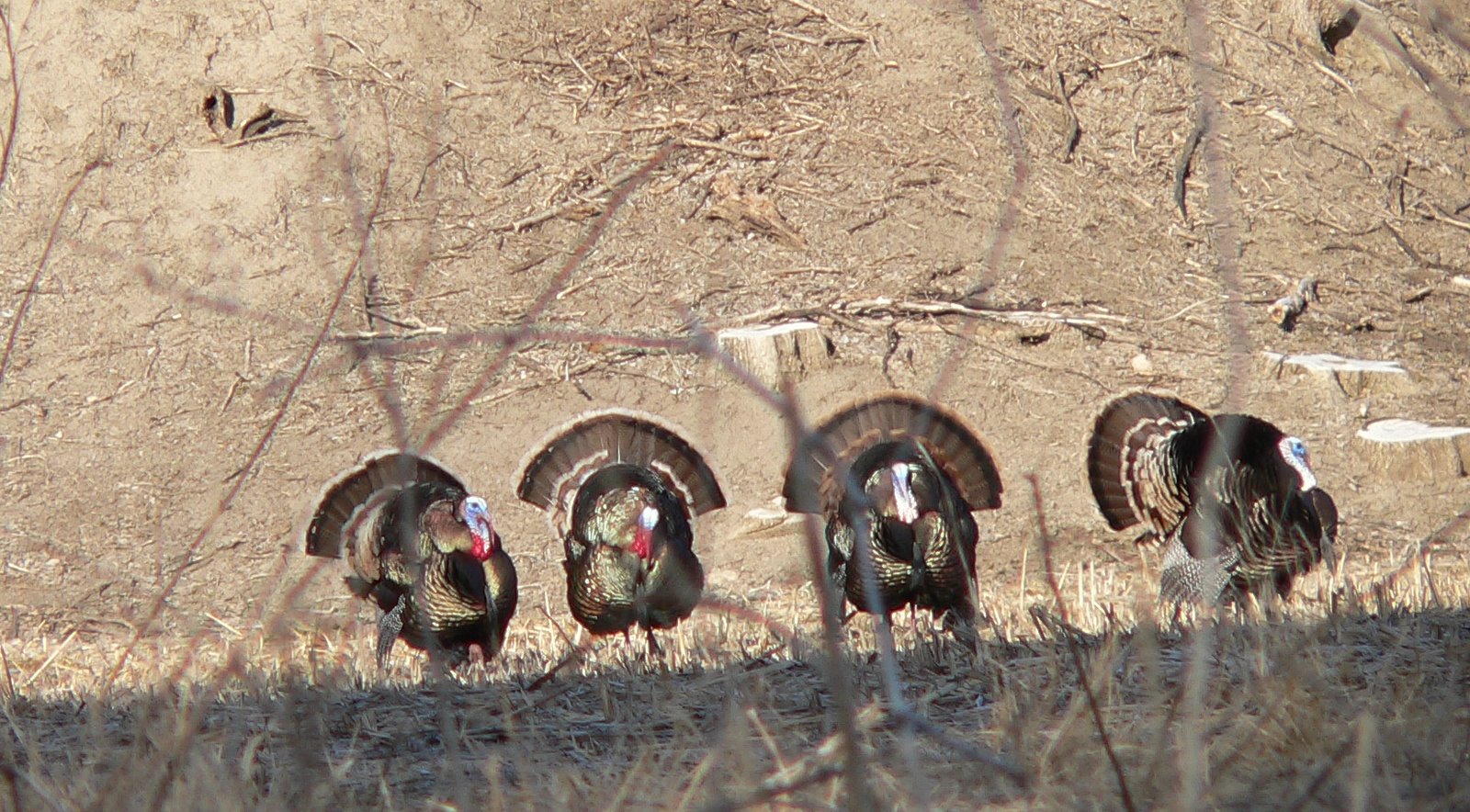
The big tom on the right is the bird that I killed.

One of the many groups that came no closer because of the dead turkey.


Wednesday, January 27, 2010

Gamemaster Jet

Over the years I have had the privilege to meet a lot of the great men and women in traditional archery. Though I never met Jack Howard, I received a letter from him in the later years of his life. As you can read in the letter, he was near the end of his bow making days and looking to sell bows outside of his own shop. He sent me this letter along with information about his bows and a newsletter. I just came across this letter as I have had a few of the old Jack Howard bows come through my shop lately. As I write this I just sold a 60# Gamemaster Jet in beautiful condition. It is truly one of the best bows ever made.

One of my biggest regrets over the past 16 years of owning this business is that I didn't sell bows for Jack Howard. At the time I simply did not have the money to stock his bows. It was a shame. Anyway, I am sure that you will get as much joy in reading Jack's words as I did when I came across this package.

You can download the entire package in a .pdf by clicking here.

-Tom Clum


Saturday, January 23, 2010

Congrats Keith!

I would like to congratulate Wapiti bowyer Keith Chastain for completing a 15 year quest to kill an Arizona coues deer with his bow. Keith used his own "Duggan Special" Wapiti takedown and Woodsman broadheads for his hunt. Congrats on finally getting your coues deer Keith!

Tuesday, January 5, 2010

Bow Stats

With the start of the new year I figured it would be fun to share some of the bow statistics from 2009. In the past year we sold 330 recurves and longbows, not including kids bows or novelty bows. Though I don't have complete stats for all 330 bows, it still gives us a decent sample to look at.

Average weight: 50.63lbs @ 28inches
Average length: 61.05inches
52% recurves, 48% longbows
54% were used, 46% new
10% were left handed
58% were one piece
April is the busiest bow selling month, December is the slowest
We sold more Spirit bows than anything else, followed by Rampart, Mohawk, Wapiti, Bear, Hawk

Below is a graph representing the # of bows we sold at each pound of draw weight, from 29lbs up to 72lbs.


Monday, November 16, 2009

Feather Splicing

Make sure to check out the Tutorials page and see the new walk through about splicing feathers. Nothing can add the kind of personal touch or good looks to your arrows.


Monday, October 19, 2009

Decoying Deer


This was sent to me by my good friend Tom McCormick down in Iowa. We have exchanged many Emails about a lot of different topics. When it comes to whitetail deer hunting, this man flat out knows his stuff! Below is an Email that he sent to me about decoying deer.

Enjoy...

Decoying Deer


Tommy,

I wanted to send you information on my decoy "strategies". First some background info.I have been using a decoy for 17 years now. I started off simply using a Delta 3-D target (with good success!). I have tried to read everything I can on the subject and have attended EVERY seminar on decoying at the Wisconsin, Iowa, and Illinois deer classics. I'm not doing to go into great detail on the "why's" of doing things a certain way.just trust me and do it!

Best decoys: Carry-Lite and Montana Buck. ALWAYS use them as a buck. If you use the doe decoy, often other does will stomp, snort and blow everything out of the woods. I have NEVER shot a buck over a doe decoy, but I have shot at least 6-7 does over a doe decoy (two in one afternoon back in 1998). I have used only a buck for the last ten years, with no negative results. It was about 50/50 when using the doe with positive vs negative reactions.


I have experimented A LOT with the various urine based scents on the market and using them with the decoy. Bottom line.don't waste your money.

When getting your new decoy, wash it very well with scent free soap and let it sit outside for a few days. Using rubber gloves, give it a "mud-bath" two or three times and simply wash off the mud with the hose. After a few days spray it down two or three times with a scent killer spray. When I transport the decoy I wrap the main body with a large plastic garbage bag so that I NEVER touch it with my bare hands. I keep the bag around the main body of the decoy when I carry it into the woods and take it off and put in my backpack when setting up. The Carry-Lite is a real pain to set-up, however, once its set up it stays that way always.


It is next to impossible to take your Carry-Lite into the field and put it together. It is very time consuming and noisy to do so. I put it together and leave it assembled all the time. I never use it as a doe, so I glued the antlers in place.


You WILL LOSE the ears and tail carrying into the woods. I always remove the ears and tail and carry them with my foot stakes in my cloth bowcase. I have a little mesh bag I store the ears and tail in and the stakes fit well in a "double" scent free athletic sock bundle. Keeps everything quiet that way. I carry the decoy over my shoulder with a blaze orange vest over his head and neck so I don't get shot.


I thought the Montana decoy was a "joke" when I first saw them. After several years of my friends using them I gave one a try. On my very first hunt, a 150 class buck came into it. I have been sold ever since. I use the Carry-Lite on most hunts due to the "full-body" look. On long walks I use the Montana. The Montana will smell "new" when you get it. Let the sun bake it. I let it sit outside for a few days and spray it down with no scent spray. I store it in cedar chips so it has a cedar smell to it instead of a "cloth smell". Always use gloves when handling the decoys.


My Montana folds up nicely and slips into my cloth bowcase with my bow. I use scent free tube socks to store the stakes inside the case.


Most "EXPERTS" don't use decoys until November. I start early, due to experimentation over the years. I shot a 157inch buck on October 12th that wanted to KILL the decoy. Most early season encounters are friendly, such as "who is this new guy". In November, however, it gets personal.they want to destroy the thing!

Set-up: Set the decoy UPWIND from your stand and have it face directly at you. I set mine EXACTLY at 20 yards so the buck with circle down-wind of him to face him head-on. This gives me a 10-15 yard shot. They come into the decoy at around a 45 degree angle, never directly "head-on". If you remove the antlers from one side, they will attack the "weak-side". My Carry-Lite has been knocked over at least 6 times over the years! I have shot three bucks that jumped and turned and came back to fight the decoy again with blood pouring out of them, not knowing that they had been arrowed. One of those I shot a second time because I thought I must have missed!


Rattling: I only rattled in two bucks during a 10 year period. I simply quit doing it because I was convinced rattling "didn't work". I now use a rattle bag with the decoy and have had OK success. Morning seems to be the best time and the decoy will give the buck a "visual" to bring him the "rest of the way".


Grunting: I use a Rod Benson grunt call made in Michigan. I have called in over 50 bucks with that call and use it a lot. The use of the decoy really brings them in close with the grunt call. Did I give you a grunt call when you were at the Clinton wrestling camp?


Set-up: Most hunters use a decoy in the open fields. It works the best when deer can see it from a distance. I use it in the deep woods also. Just as long as it doesn't startle them when coming down the trail.


VERY IMPORTANT: Tail position.you can't change it on the Montana, but you can adjust it on the Cary-Lite. Have the tail positioned at a 90 degree angle to the body (pointing straight back from the deer). I have used real deer tails and have used white plastic strips on the tail to produce "movement" in the wind. Just use the tail that comes with it and don't bother with other options. The use of tail movement was "big" several years ago, but most experts are now recommending no movement. It seem to drive the buck "nuts" when the decoy doesn't move.


You will be amazed how many deer don't see your decoy. That's when grunting will help. I have friends who tie fish line to a bush by the decoy and tug on it if the buck doesn't see it. The movement of the bush and noise causes the buck to look.


Ground blinds: The deer will never pay attention to you in the Double Bull when you have a decoy placed 20 yards upwind.


Summary: My 2nd, 4th and 5th biggest bucks were all shot over a decoy. They add a ton of fun to your hunts just by observing the reactions of the deer that see them. It can be a REAL PAIN to lug the Carry-Lite into the woods at times. But when they work all the effort pays off. I have had friends drop arrows, have stands "creak" at the wrong time, miss the deer with the first shot and still get the buck due to their "fixation" on the decoy. From October 10th to January 13th, 99% of my hunts are with a decoy!!!! I have at least 10 friends who now use them with the great success.


Please pass the above info on to Tom Sr. and Danny.


Good hunting Tommy!


Tom McCormick

Saturday, October 10, 2009

Blood, Sweat & Llamas

By Del Jolly:

To say my elk hunting career isn't the typical beginning to this long tradition would be an understatement. It pains me to say it, but I could be considered the trust fund kid of elk hunting. Which my Dad takes pleasure in reminding me of every year.

Each year my Dad, Lee (a long time friend and original member of our 3 man hunting group), myself and the occasional elk hunter who has seen the product of our hard work, go on a 10 day elk hunting trip with llamas. We (and when I say we I mean my Dad and Lee) own 4 llamas. The four llamas, Dante, Scooter, Feathers, and Licorice are truly great animals. Each has their own personality uniquely different from each other. Dante is our lead animal, very stoic and strong. Scooter is the powerhouse, sometimes I think he can haul as much as a Clydesdale. Licorice reminds me of Andre The Giant in the movie A Princess Bride, a little slow yet very lovable. And finally Feathers who is happy to regurgitate his cud and spray it on anyone who even ponders the idea of approaching him. Each animal is a gilded male (neutered) and each has his place in the pecking order.


In the beginning we only had two llamas, Dante and Scooter. It took one full spring and summer to train them to pack. The beginning of the process was very difficult considering I had no experience with llamas in the past. Little things, like making sure their backs we clear of debris before putting on the saddles, took weeks to master. But after a whole summer of continuous work (a minimum of several hours a day 3 to 4 days a week) Dante and Scooter ended their first season packing out TWO Pope & Young bulls.

Having successfully used our two llamas for the first time we jumped on the chance to acquire two more. You would be surprised how easy it is to find people giving away llamas. A co-worker of my mother-in-law owned Licorice and Feathers, he was as pleased to get rid of them as we were to have them. The new, untrained llamas saw how hard Dante and Scooter worked, which made their own training a breeze.

The benefits of being born to a elk hunting legend (in his own mind) are brought up annually. Even if they weren't I can't help but think of how lucky I am. Without the llamas we wouldn't be able to responsibly hunt as far back in the wilderness as we do. I simply would not have the confidence to hunt where ever, and I do mean where ever my body can take me. With a split hoof made much like an elk's, llamas can go almost anywhere an elk can. This completely alleviates the little devil that pops up on your shoulder saying "Do you really think we should kill an elk all the way back in this hell hole?"

Another great benefit is the maintenance free aspect of llamas. Once we arrive at base camp and stake out the llamas (which takes a total of five minutes), we do not have to feed or water them after a long day of hunting. Only every three days do we move the llamas to a new grazing area. We also take them to water every few days, but more for our own conscience than their needs. Being kin the the camel, we have seen them not drink for over 14 days even though we've brought them to water several times. Most the areas we hunt have plenty of moisture in the vegetation.

Some people have asked "Why llamas and not horses?" In our opinion, the two biggest reasons are the cost, and 1000lbs of nervous muscle. The year round maintenance costs for a llama is less than half that of a horse. If the cost of a horse isn't a problem (remember I am just a blue blood of elk hunting, my bank account could bring a grown man to tears) then maybe riding a horse that spooks will convert you to llamas. Over the years I have known plenty of hunters whose horse has spooked, tossing them for a loop.

Horses are big and strong enough to do what they please with their rider. Llamas on the other hand are roughly 400 lbs and don't spook easily. Since you can not ride a llama there is no chance they will buck you off. I have personally seen a sow and her two cubs walk within 100 yards of our llamas, the only thing they did was an alarm call. The best way I've heard a llama alarm call described is that it sounds like a lunatic laughing uncontrollably.

Just to be clear, I am not saying that getting hurt by a llama hasn't happened, I have just not personally heard of it or seen it. I also understand that not every horse spooks, but unless you are fortunate enough to use good horses, they can be flat out dangerous.

I owe much of my elk hunting success to the animals that make hunting deep in the wilderness a possibility. Using our 4 llamas is a privilege that I am thankful for. I always try to remember how lucky I am to have these great animals. And if I ever forget, all I have to do is wait until the following bow season for my dad, "a guy from Detroit", who early in his hunting career thought wild elk to be as elusive as the unicorn, to remind me of my inheritance of his blood, sweat and llamas.

~Del Jolly

Several other thoughts: Even though we train our llamas to pack all our gear, I always carry my bow and arrows in my hand. Losing the most important tools for dispatching elk on an elk hunting trip can bring rain to any parade. I also learned the hard way to spend the extra money on quality arrows that don't break if they ricochet off a dandelion. I bought dozens of the cheap arrows under the mind set that arrows break (only because I buy the cheap ones) when they hit the ground. Now I only shoot Carbon Express Heritage 250s. The extra money spent up front far exceeds the money lost in the long run. These arrows are by far the best I've found. Of the thousands of arrows I've shot this summer I can only remember breaking two. One at the Colorado Traditional Archers Society shoot on the Iron target course, which breaks any arrow if you miss, and one was scratched pretty deep off of a rock while shooting at my local range in Golden.

So when packing with llamas, I suggest caring your bow. It is also well worth the extra money for quality arrows, such as the Carbon Express Heritage shafts.